Structural Drying in Rochester, MN
Surface-dry is not dry. The drying team dries framing, subfloor and wall cavities with air movers and LGR dehumidifiers and pulls the equipment only when the readings say the structure is dry.
(888) 432-4933Start drying the Rochester structure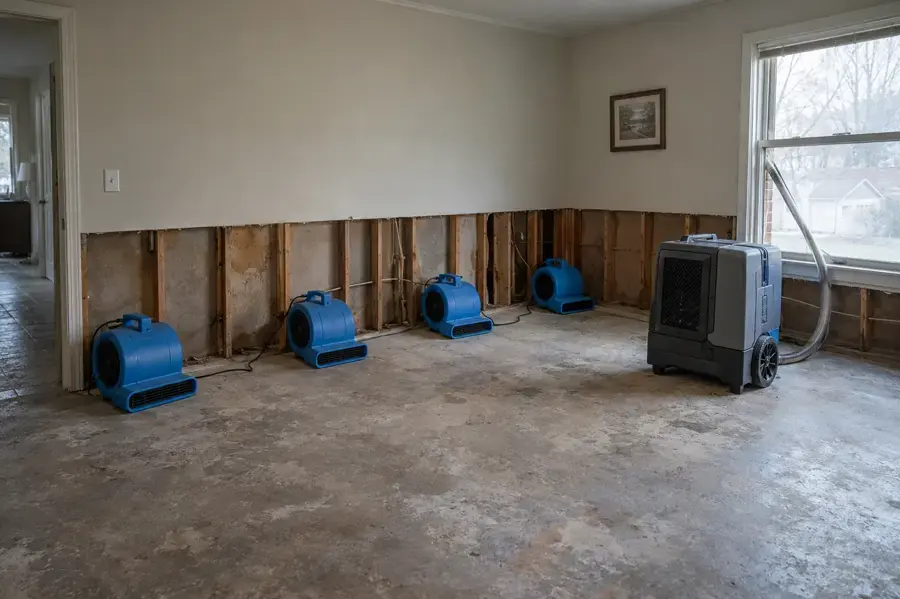
How structural drying is handled in Rochester, MN
- 01
Walkthrough
The tech who does the walkthrough maps every wet material with pinless meters and thermal imaging and sets the category and class of the loss.
- 02
Extraction
The extraction crew pulls standing water with truck-mounted units, lifts saturated pad and cuts only what the readings say is lost.
- 03
Drying
The drying team sizes air movers and LGR dehumidifiers to each room's evaporation load and logs psychrometric readings every day.
- 04
Verification
Equipment leaves when wet materials read within 2 to 4 points of a dry reference, which is the IICRC S500 goal, and the file is closed with photos and logs.
What does structural drying cost in Rochester, MN?
In Rochester, MN, structural drying typically runs $1,000 to $6,000 on its own, depending on the class of loss, the number of rooms and how many equipment days the readings require.
- A few air movers
- One LGR dehumidifier
- Three to four days
- Walls, ceilings and insulation
- Several LGR units
- Daily readings and adjustments
- Hardwood, plaster, block or slab
- Desiccant dehumidifiers
- Longer drying period
What moves the number: class of loss, number of rooms, material density, equipment days and how fast drying started. For a closer planning range, try the water damage cost calculator. These are typical ranges, not quotes.
How to help while the structure dries
- 1
Leave the equipment running. Turning air movers off to save power resets the clock.
- 2
Keep doors and windows closed. Humid outside air slows dehumidifiers.
- 3
Set the thermostat near 70. Moderate warmth helps evaporation.
- 4
Call with questions. The drying team adjusts the plan to the daily readings.
Structural drying is the part of water damage restoration that decides whether problems come back. A room can look dry in a day while the bottom plate, the subfloor and the insulation stay wet for weeks. Those hidden materials are where odor, swelling and growth start, so the drying team measures them, not the surface.
How a structural drying plan is built
The plan starts with the class of the loss. Class 1 is a small area with low-porosity materials; Class 2 is a whole room with carpet and wicking up the walls; Class 3 is water from above soaking walls, ceilings and insulation; Class 4 is dense materials like hardwood, plaster, concrete block and slab that hold water tightly. The class sets how many air movers and how much dehumidification each room needs.
- Air movers set to each room's evaporation load, aimed along wet walls and floors.
- LGR (low grain refrigerant) dehumidifiers that keep pulling water out of the air even as the room dries.
- Desiccant dehumidifiers for Class 4 materials and cold spaces.
- Injection drying and specialty mats for wall cavities, cabinets and hardwood.
Readings, not a calendar
Every day, most crews record moisture readings on the wet materials and psychrometric readings of the air: temperature, relative humidity and grains per pound. The goal is for wet materials to read within 2 to 4 points of a dry reference material in an unaffected part of the same building. When they do, the equipment comes out. The daily log becomes part of the insurance file.
Rochester basements with concrete block walls and older homes with plaster are classic Class 4 drying jobs. They take longer, and the drying team plans for desiccants and more days from the start.
Season makes a difference
In winter, heated indoor air in Rochester is dry, and drying often goes faster. In humid July and August, dehumidifiers work harder and the drying team may close off rooms to control the air. The drying time estimator shows how class, materials and season change the typical window.
The EPA mold page explains the 24 to 48 hour window for drying wet materials, and University of Minnesota Extension covers moisture control in Minnesota homes.
Walls or floors still wet after a leak?
(888) 432-4933Rochester water removal, 24/7Related water damage services in Rochester
Structural Drying across Rochester
The restoration team works all of Rochester, from Pill Hill and Kutzky Park to Northrop, Cascade Lake and Eastwood, plus Byron, Stewartville, Kasson, Pine Island and Oronoco.
Every neighborhood and ZIP coveredStructural Drying questions in Rochester, MN
Straight answers on structural drying in Rochester homes and buildings.
(888) 432-4933Water still moving? Call Rochester now.What is the difference between surface drying and structural drying?
Surface drying makes a room look dry. Structural drying dries the framing, subfloor, insulation and wall cavities, verified with meters.
Why can't the equipment come out once the carpet feels dry?
Materials under and behind the carpet usually still hold water. Pulling equipment early traps that moisture.
What is an LGR dehumidifier?
A low grain refrigerant dehumidifier keeps removing water from the air even as the air gets drier, which a household dehumidifier cannot do well.
Why are the air movers so loud?
They move a lot of air across wet surfaces to speed evaporation. The noise is temporary and the job goes faster with them running.
How much electricity does drying use?
Several air movers and a dehumidifier can add a noticeable amount to the bill for a few days. Many insurers treat it as part of the claim.
How is the dry goal confirmed?
Wet materials are compared with a dry reference material in the same building; within 2 to 4 points is the usual goal.
Dry it right, dry it once.
The drying team measures every day and pulls equipment only when the structure reads dry.